통합 검색
통합 검색
LengtheningㅣCorrection
Gangnam Champion Orthopedic Surgery
Hospital
- Limb Lengthening & Correction
- Spine & Joint
- Hand & Foot
- Rehabilitation
Long Toe
Toe Shortening Surgery
in Korea
Correction for
Long Second Toe
Long Third Toe
Excessively Long Toes
Do you have a toe that looks too long compared with the surrounding toes?
An excessively long toe may cause more than a cosmetic concern. It can repeatedly hit the inside of a shoe, create pressure at the tip of the toe, cause calluses, or contribute to discomfort when walking.
A long second or third toe is particularly common, although any toe can be affected.
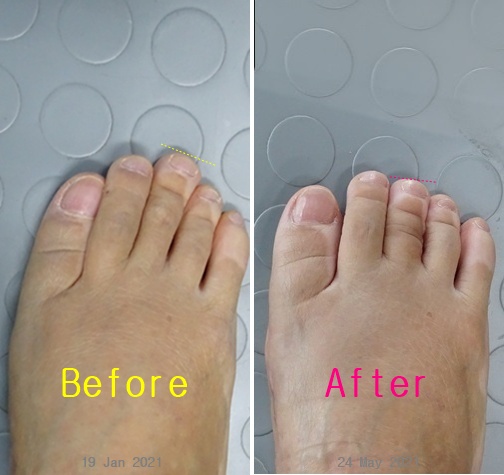
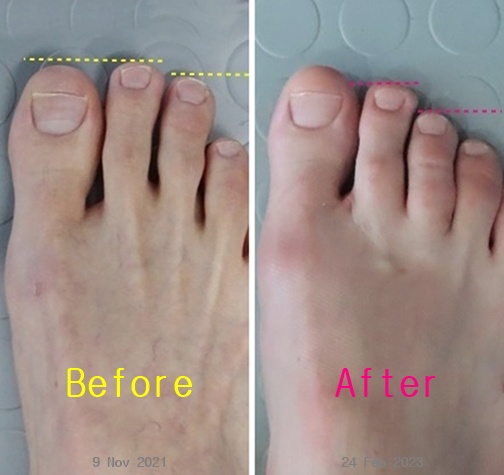
At Gangnam Champion Hospital, toe shortening surgery is individually planned according to the length, alignment, bone structure, and overall proportions of the patient's foot.
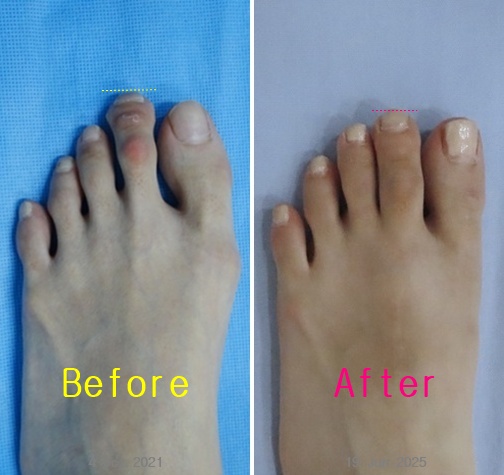
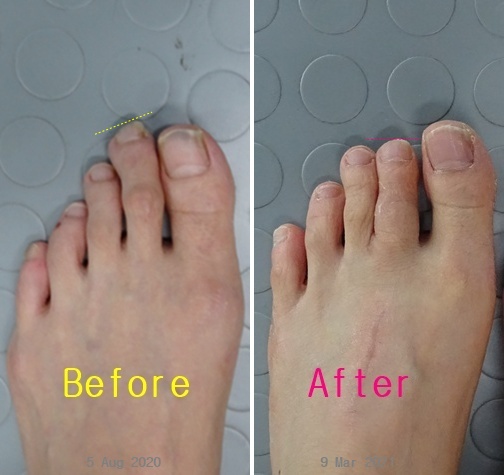
Depending on the condition, one or multiple toes may be shortened during the same surgical treatment.
The goal is not simply to make a toe shorter, but to create an appropriate length and alignment in relation to the surrounding toes while maintaining function.
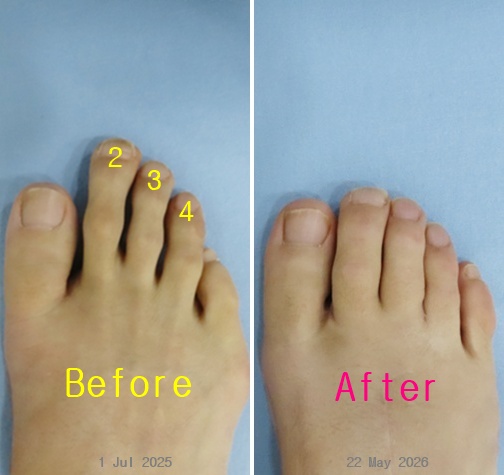
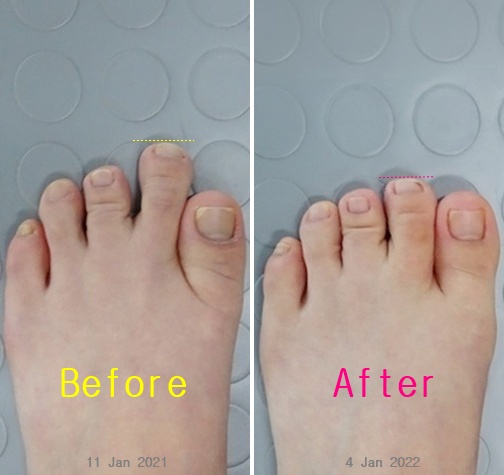
1. What Is an Excessively Long Toe?
A long toe is a condition in which one or more toes are disproportionately long compared with the surrounding toes and overall foot structure.
It commonly affects the:
✔ Second toe
✔ Third toe
✔ Multiple lesser toes
A long second toe may extend beyond the great toe and become particularly noticeable when standing barefoot or wearing open-toe shoes.
The degree of toe length varies considerably between individuals.
Having a second toe longer than the great toe does not automatically mean that treatment is necessary. Surgery is generally considered when the toe causes significant pain, shoe problems, deformity, or individual concerns about its appearance.
2. Why Does a Toe Look Too Long?
There are several possible reasons.
These may include:
✔ Congenital bone length
✔ Individual foot anatomy
✔ Growth differences
✔ Hereditary factors
✔ Relatively long phalangeal bones
✔ Relatively long metatarsal bones
✔ Shortening of an adjacent toe or metatarsal
✔ Associated forefoot deformities
Therefore, it is important to determine which bone is actually responsible for the apparent difference in toe length before deciding on surgery.
3. Long Second Toe & Morton's Toe
A second toe that extends beyond the great toe is sometimes referred to as Morton's toe.
However, the external appearance of a long second toe can result from different underlying anatomical relationships.
In some patients, the second toe or second metatarsal may be relatively long.
In others, the great toe or first metatarsal may be relatively short, making the second toe appear longer.
For this reason, treatment should not be determined from appearance alone.
Physical examination and X-rays can help identify the underlying anatomy.
4. Symptoms of an Excessively Long Toe
A long toe may cause:
Shoe Problems
✔ Toe pressure inside shoes
✔ Difficulty finding comfortable shoes
✔ Repeated rubbing against the front of the shoe
✔ Difficulty wearing certain types of footwear
Physical Symptoms
✔ Pain at the tip of the toe
✔ Callus or corn formation
✔ Nail irritation
✔ Toe bending or deformity
✔ Pressure-related discomfort
✔ Pain during prolonged walking or standing
Cosmetic Concerns
Some patients are primarily concerned about:
✔ One toe appearing disproportionately long
✔ Uneven toe length
✔ Overall forefoot proportions
✔ Appearance when barefoot
✔ Appearance in sandals or open-toe shoes
The need for treatment should be considered individually according to symptoms, anatomy, and the patient's goals.
5. Is It Really a Long Toe — or Is the Adjacent Toe Short?
This distinction is particularly important.
Sometimes a toe appears excessively long because an adjacent toe is abnormally short.
For example, brachymetatarsia can cause one toe to appear shorter or elevated because the corresponding metatarsal bone is shortened.
This can make an otherwise normal-length adjacent toe appear unusually long.
Therefore, evaluation should determine whether the appearance is caused by:
✔ A genuinely long toe
✔ A shortened adjacent toe
✔ Brachymetatarsia
✔ A combination of short and long bones
✔ Overall forefoot alignment
If the main problem is a short toe or shortened metatarsal, treatment may require a different approach such as bone lengthening rather than toe shortening.
Learn More About Brachydactyly & Brachymetatarsia Surgery
6. Long Toe & Hallux Valgus
A long second or third toe may also be seen together with hallux valgus (bunion) or other forefoot deformities.
When hallux valgus pushes the great toe toward the lesser toes, crowding and altered toe alignment may make an already long toe more symptomatic.
In these cases, it is important to evaluate the entire forefoot rather than treating toe length alone.
Depending on the patient's anatomy and symptoms, treatment planning may need to consider both the long toe and associated hallux valgus.
Learn More About Hallux Valgus & Bunion Surgery
→ [ Hallux Valgus ]
7. Non-Surgical Treatment
Not every long toe requires surgery.
When symptoms are mild, conservative measures may include:
✔ Shoes with a wider or deeper toe box
✔ Protective padding
✔ Appropriate insoles
✔ Shoe modification
✔ Management of calluses or pressure points
These measures may help reduce discomfort but cannot shorten the underlying bone.
If the actual length of the toe needs to be structurally reduced, surgical shortening is required.
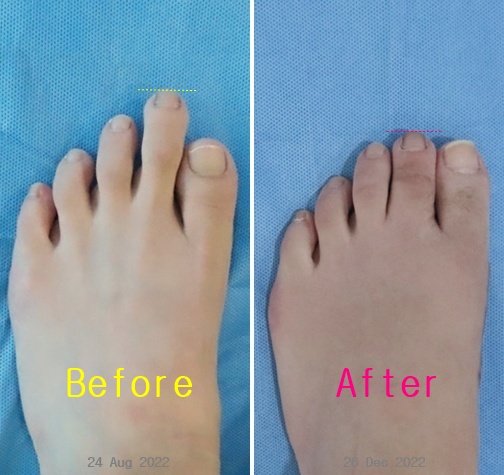
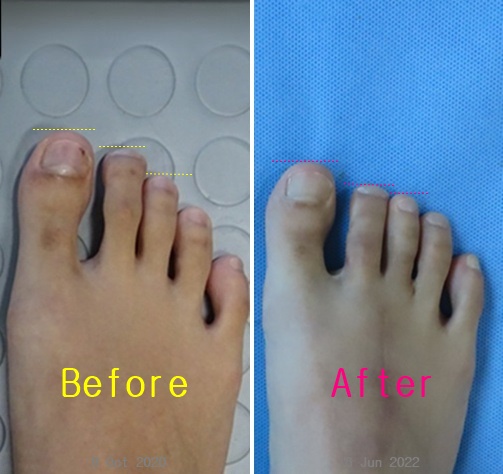
8. When Is Toe Shortening Surgery Considered?
Surgery may be considered when:
✔ A toe is excessively long compared with surrounding toes
✔ Persistent shoe irritation occurs
✔ Toe-tip pain develops
✔ Calluses repeatedly form
✔ The long toe develops secondary deformity
✔ Walking or daily activities become uncomfortable
✔ The patient has significant concerns regarding toe proportion
The decision should be based on examination, X-rays, symptoms, and individual treatment goals.
9. Toe Shortening Surgery
Individualized Toe Length Correction
Toe shortening surgery reduces the length of an excessively long toe by correcting the underlying bone.
The amount of shortening should be carefully planned according to:
✔ Original toe length
✔ Length of adjacent toes
✔ Overall forefoot proportions
✔ Bone anatomy
✔ Joint alignment
✔ Soft-tissue condition
✔ Patient's desired correction
The objective is to achieve a balanced toe length rather than simply removing as much bone as possible.
10. Toe Shortening Osteotomy
A toe shortening osteotomy involves cutting the appropriate bone and removing or repositioning a selected amount of bone to reduce the overall toe length.
The corrected bone is then stabilized as required.
Depending on the underlying anatomy, surgery may involve the:
✔ Phalangeal bone
✔ Metatarsal bone
✔ Joint alignment
✔ Combination of bone and joint correction
The surgical technique is selected according to the location and degree of excessive length.
11. Minimally Invasive Approach
When medically appropriate, surgery may be performed using a small-incision or minimally invasive approach to reduce unnecessary soft-tissue disruption and surgical scarring.
However, the incision and surgical technique depend on the bone requiring correction and the extent of the deformity.
The priority is accurate correction, stable fixation, proper alignment, and safe healing.
No surgical technique can guarantee an invisible scar.
12. Can Multiple Long Toes Be Shortened?
Yes, in selected patients.
Some patients have more than one disproportionately long toe.
When appropriate, multiple toes may be shortened during the same surgical session.
Rather than treating each toe independently, the desired lengths can be planned in relation to the entire forefoot to create a more balanced toe contour.
The appropriate amount of correction for each toe is determined individually.
13. Correction of Associated Toe Deformities
An excessively long toe may also develop abnormal alignment.
Examples include a toe that:
✔ Points downward
✔ Elevates upward
✔ Deviates sideways
✔ Rotates
✔ Develops a flexion deformity
✔ Overlaps another toe
When necessary, toe length and alignment may be addressed together.
Patients with persistent or recurrent deformity following previous toe surgery can also be evaluated for possible revision treatment.
14. Cinderella Foot Surgery & Toe Shortening
The term “Cinderella foot surgery” is sometimes used online to describe cosmetic or reconstructive procedures intended to improve foot shape and proportion.
It is not a specific medical diagnosis or a single standardized surgical procedure. Depending on the individual condition, the term may refer to procedures such as toe shortening, bunion correction, or correction of other toe deformities.
For patients concerned about an excessively long second or third toe, toe shortening surgery may be considered when appropriate based on the patient's anatomy, symptoms, and treatment goals.
15. Before Surgery
Preoperative evaluation may include:
✔ Physical examination
✔ Standing foot evaluation
✔ X-rays
✔ Measurement of toe length
✔ Evaluation of the phalanges and metatarsals
✔ Joint alignment
✔ Associated hallux valgus or other deformities
✔ Previous surgical history
✔ Desired degree of correction
Photographs can also be useful when planning the overall proportion of the toes.
16. Anesthesia
Depending on the procedure and individual medical condition, toe shortening surgery may be performed using regional/local anesthesia combined with sedation.
This may allow surgery to be performed without general anesthesia in selected patients.
The appropriate anesthetic technique is determined after medical evaluation.
17. Surgery & Recovery
For selected, relatively simple toe shortening procedures, surgery may take approximately 15–30 minutes per toe, although the actual time varies according to the bone involved and complexity of correction.
Following surgery:
✔ A cast may not be required for selected procedures
✔ A postoperative surgical shoe may be used
✔ Protected walking may be possible according to the surgeon's instructions
✔ The wound should be kept clean and protected during early healing
✔ Follow-up X-rays may be required to evaluate bone healing
✔ Activity is gradually increased according to healing progress
Recovery varies according to the surgical technique, number of toes treated, fixation method, and individual healing.
18. Possible Risks and Complications
As with any orthopedic procedure, complications are possible.
Potential risks include:
✔ Infection
✔ Delayed wound healing
✔ Delayed union
✔ Nonunion
✔ Fracture
✔ Implant irritation or failure
✔ Nerve irritation or numbness
✔ Loss of correction
✔ Residual deformity
✔ Toe malalignment
✔ Excessive or insufficient shortening
✔ Need for additional surgery
Potential benefits, limitations, and risks should be discussed before treatment.
19. Frequently Asked Questions
Q. How long does toe shortening surgery take?
For selected simple procedures, surgery may take approximately 15–30 minutes per toe. The actual surgical time depends on the number of toes treated, the bone requiring correction, fixation method, and associated deformities.
Q. Can I walk after toe shortening surgery?
Protected walking may be possible relatively early after selected procedures using a postoperative surgical shoe. The timing and amount of weight bearing depend on the operation and stability of fixation.
Q. Will I need a cast?
A cast may not be necessary after selected toe shortening procedures. A postoperative surgical shoe or other protection may be used instead.
Q. Will there be a scar?
Any surgical incision can leave a scar. When appropriate, a small-incision technique may be used to minimize the incision while allowing safe correction. Scar appearance varies between individuals and an invisible scar cannot be guaranteed.
Q. How much can my toe be shortened?
There is no single amount that is appropriate for every patient. The planned shortening depends on the original toe length, bone anatomy, joint condition, surrounding toe lengths, and overall foot proportions.
Q. Can several toes be shortened at the same time?
Yes, multiple toes may be corrected during the same surgical session in selected patients. The treatment plan is individually determined after examination and X-rays.
Q. What if my toe is long and crooked?
Length and alignment can be evaluated together. Depending on the deformity, shortening osteotomy may be combined with additional correction to improve toe alignment.
Q. Can previous toe surgery complications be corrected?
Revision treatment may be considered for selected patients with persistent deformity, malalignment, pain, implant problems, or other complications following previous surgery. The appropriate treatment depends on the existing bone and joint condition.
20. Long Toe & Toe Shortening Surgery in Seoul, South Korea
Gangnam Champion Hospital provides evaluation and surgical treatment for:
✔ Long second toe
✔ Long third toe
✔ Excessively long toes
✔ Multiple long toes
✔ Toe shortening
✔ Toe shortening osteotomy
✔ Associated toe deformities
✔ Revision toe surgery
Treatment is individually planned according to the patient's toe length, bone structure, foot proportions, symptoms, and treatment goals.
International patients may receive an initial assessment before traveling to Korea.
Clear photographs and recent foot X-rays can be helpful for preliminary evaluation.
Final diagnosis and surgical planning require appropriate medical examination.
International Patient Consultation
International patients interested in long toe surgery or toe shortening surgery in Korea may contact us before arranging travel.
For preliminary review, it may be helpful to provide:
✔ Clear photographs of both feet while standing
✔ Top and side views
✔ Recent foot X-rays, if available
✔ Age
✔ Previous foot surgery history
✔ Current symptoms
✔ Which toe or toes are of concern
✔ Preferred travel dates
Information regarding consultation, surgical scheduling, expected stay in Korea, and postoperative follow-up can then be discussed.
Gangnam Champion Hospital
525 Ogeum-ro, Songpa-gu
Seoul, South Korea
T : +82-2-408-7575
E : drahn818@naver.com
◆: [ Consultation ]
Patients from overseas may contact the hospital for information regarding consultation, treatment scheduling, expected stay in Korea, and follow-up care.
This page provides general medical information and does not replace an individual medical consultation. Surgical indications, techniques, recovery periods, risks, and outcomes vary according to each patient's condition.
-축소 150.jpg)